
• Skip to main content

MissNowMrs

Online Married Name Change Service + App

  • Our Story
  • Reviews
  • FAQ
  • Name Change FAQ
  • Name Change Advice
  • How It Works
  • Gift Cards
  • Log in
You are here: Home / Archives for Married Name Change

Jul 22 2026

How to Change Your Name on Insurance After Marriage

Newlywed woman at a bright modern insurance agency counter handing her marriage certificate and updated ID to an agent, illustrating how to change your name on insurance policies after marriage, wedding ring visible on her left hand

If you’re working through your post-wedding to-do list, updating your insurance policies is one of the most important steps to tackle early. Knowing how to change your name on insurance after marriage protects your coverage, keeps your claims from being flagged, and ensures every policy reflects your new legal identity. A name mismatch between your ID and your insurance records can cause real problems when you least expect them.

The process is more manageable than it sounds, but it does require coordinating across several different policies. One prerequisite: most insurers want your updated government-issued ID alongside a certified copy of your marriage certificate, which means updating your Social Security card and driver’s license first. how to change your name after marriage covers the full order of legal documents. Once your ID reflects your new name, here’s how to work through each policy type.

Why Insurance Name Updates Matter More Than You Might Expect

When your legal name changes and your insurance records don’t follow, the consequences can range from annoying to genuinely costly. A health insurer may flag a claim because the name on your ID doesn’t match the name on file. An auto claim can be delayed over an identity discrepancy. And in the case of life insurance, a mismatch on your beneficiary records can complicate payouts at a moment when your family needs certainty.

Insurance companies use your name to verify your identity and connect your policy to your claims accurately. Keeping your records current isn’t just administrative tidiness. It’s making sure your coverage actually works when you need it.

Which Insurance Policies to Update After You Change Your Name

The list is longer than most newlyweds expect. Here are the main policies to contact when updating your name on insurance policies after marriage:

Health Insurance

Marriage qualifies as a qualifying life event (QLE), which gives you a special enrollment period, typically 60 days from your wedding date. This is the window to update your name AND to make coverage changes, including adding your spouse to your plan or joining theirs outside of open enrollment.

If your health insurance comes through your employer, contact your HR or benefits department. If you purchased your plan through the marketplace or directly from an insurer, call member services or log into your online account. You’ll need:

  • Your updated government-issued ID (driver’s license or state ID)
  • A certified copy of your marriage certificate

Don’t delay on this one. The 60-day window closes fast, and missing it means waiting until open enrollment to make any coverage changes. Updating your name on health insurance after marriage is the most time-sensitive item on this list.

Auto Insurance

Auto insurance name updates are among the most straightforward. Call your agent or log into your account and request a name change. Have your updated driver’s license and marriage certificate ready.

Marriage is also an ideal time to review your auto coverage as a couple. Many insurers offer multi-car discounts when both vehicles are on a single household policy, and combining can mean real savings. For a broader look at bundling and reviewing all your coverage as newlyweds, see updating and bundling insurance after marriage.

Life Insurance

Life insurance has two separate updates to make, and both matter. First, update the policyholder name on the policy itself. Second, review your beneficiary designations. Marriage often changes who you want to name as a beneficiary, and your designation is a legally binding document that supersedes anything written in a will.

Contact your insurer’s policy services team directly. If your life insurance comes through an employer, your HR department handles both types of updates.

Homeowners or Renters Insurance

If you rent, this is the time to add your spouse to your renters policy, or to consolidate two separate policies into one. If you own a home, notify your homeowners insurer of the name change and any changes to the household. Both updates may affect your coverage details and premium.

Other Policies to Check

These are easy to overlook in the post-wedding rush:

  • Dental and vision insurance
  • Pet insurance
  • Umbrella or liability policies
  • Annual travel insurance plans
  • Long-term care or disability insurance

How to Change Your Name on Insurance Policies After Marriage

The process varies slightly by insurer, but follows a consistent pattern across policy types:

  1. Gather your documents. You’ll need your marriage certificate and your updated government-issued photo ID. Some insurers will accept a marriage certificate before your ID is updated, but most prefer both. If you need a certified copy of your certificate, how to get a certified copy of your marriage certificate walks you through ordering one.
  2. Contact each insurer directly. Call member services or log into your online account for each policy. Ask specifically about the name change process. Some companies have a dedicated form; others handle it over the phone or through a secure document upload.
  3. Submit your documentation. Ask about the preferred submission method (online upload, email, or mail) and confirm before sending anything.
  4. Request written confirmation. Ask for a confirmation email or updated policy documents showing your new name. Keep these on file with your other important marriage paperwork.
  5. Review your coverage while you have the account open. Marriage changes your needs. Double-check deductibles, coverage limits, and beneficiary designations before closing out.

Pro tip: If managing multiple name change updates at once feels like a lot, MissNowMrs walks you through every agency and institution where your name needs to be updated, not just insurance. More than 500,000 newlyweds have used the service to simplify the entire process. complete name change kit for newlyweds

What to Expect from Your Insurance Insurer’s Processing Timeline

Insurance name changes are generally quick to submit, but turnaround times vary by company and policy type. For a full breakdown of timelines across all the institutions you will need to notify after marriage, see how long you have to change your name after marriage.

Frequently Asked Questions About Changing Your Name on Insurance After Marriage

Do I need to update my Social Security name before contacting my insurance company?

For most insurance updates, yes. Insurers will ask for your updated government-issued ID, which requires a prior Social Security name change to obtain. Getting your card updated first creates a clean documentation chain that every insurer will accept without question. Social Security name change covers the full process.

Does health insurance update automatically after I get married?

No. Marriage opens a special enrollment period but nothing updates automatically. You need to contact your insurer or HR department within 60 days of your wedding to make any changes, including a name update or coverage adjustments.

Will changing my name affect my insurance premiums?

A name change itself doesn’t affect your premium. However, if you consolidate policies, add a spouse to your coverage, or update your address at the same time, your rate may change based on those factors. Always ask your insurer to confirm before and after any combined changes.

What if I can’t find my marriage certificate to submit?

You can order a certified copy from the county clerk’s office in the county where your marriage was recorded. Most counties offer online ordering, with fees typically ranging from $10 to $30 per copy. It’s worth ordering a few extras upfront since you’ll need copies for multiple institutions during the name change process.

Does a hyphenated name still require updating insurance policies?

Yes. Any legal name change, including a hyphenated or blended name, needs to be reflected across all your insurance policies. The documents required and the process are the same regardless of which name option you chose after marriage.

You’ve Got This

Between the thank-you notes, the adjustment to married life, and everything else on your plate, insurance paperwork isn’t the most exciting part of the post-wedding season. But it’s one of the most practical things you can do for your household in the months after your wedding.

Start with health insurance since the enrollment deadline is real, then work through the rest of your policies steadily. A few phone calls spread across a couple of weeks is genuinely all it takes. Before long, your coverage reflects who you are now, which is exactly where it should be.

And if you’d like help managing the full picture of your name change well beyond insurance, start your name change with MissNowMrs makes the entire process simple from start to finish.

Written by Danielle Tate · Categorized: Name Change After Marriage for Newlyweds · Tagged: Insurance Name Change, Married Name Change, Name Change after Marriage, Newlywed Checklist

Jul 22 2026

Filing Taxes After a Name Change: Which Name Goes on Your Return?

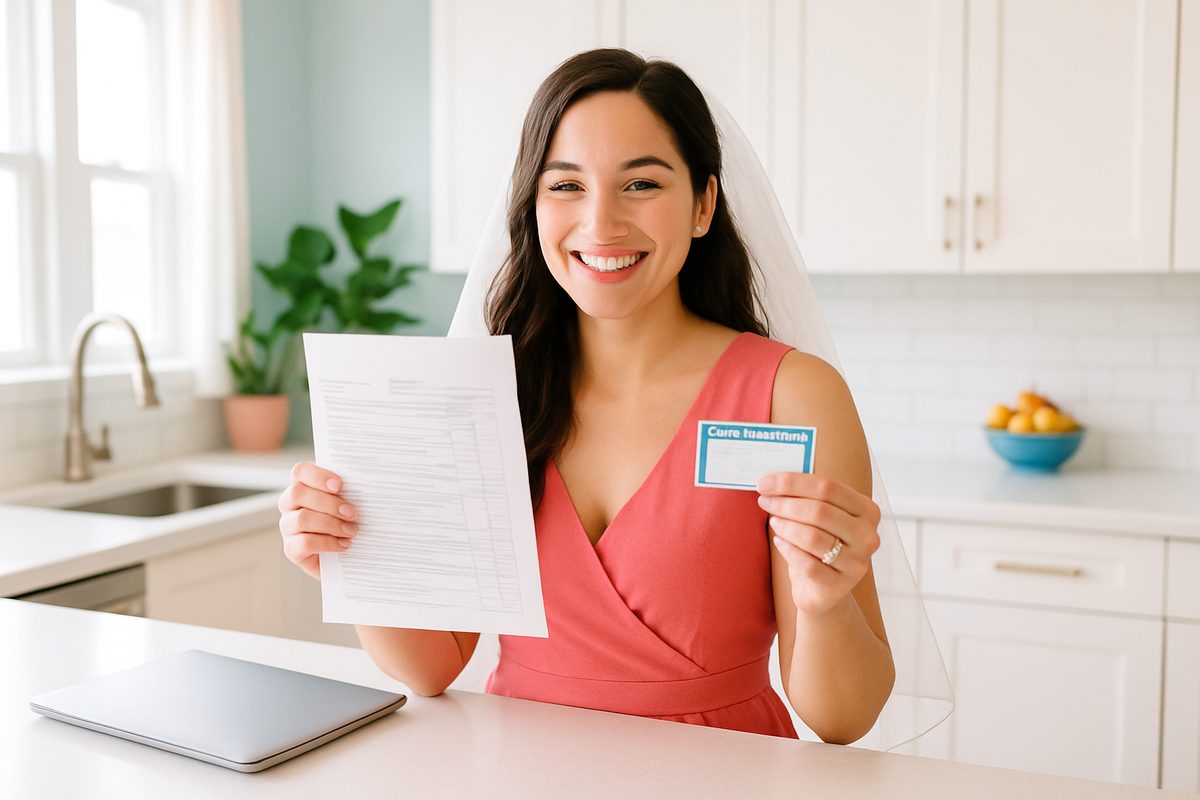
Newlywed woman holding a tax return and Social Security card with wedding ring clearly visible, representing the key documents for filing taxes after a name change and confirming SSA name update status before filing

Getting married is one of life’s biggest milestones, and the paperwork that follows can feel just as significant. When tax season arrives, one question trips up thousands of newlyweds every year: what name do you actually put on your return? If you recently changed your name after marriage, the answer is not as obvious as it sounds, and using the wrong one can get your return rejected by the IRS before a single line gets reviewed.

Filing taxes after name change is manageable once you understand the one rule that governs everything. This guide explains exactly which name to use, why the IRS cares, what to do if your name update is not finished yet, and how to make sure your return goes through on the first try.

The One Rule That Determines Which Name You Use

The IRS does not track name changes on its own. Instead, it verifies the name and Social Security number on every tax return against records held by the Social Security Administration (SSA). When those records do not match, the return is rejected. No review, no exception.

This means the name on your tax return must match the name currently on file at the SSA for your Social Security number. Not the name on your marriage certificate. Not the name on your driver’s license or your bank account. The name the SSA has in its own database, linked to your specific Social Security number.

The IRS runs this check on every return, whether you file electronically or on paper. An electronic return is rejected immediately. A paper return gets flagged during processing, which can delay a refund by weeks or longer.

What Name to Use on Your Tax Return After Marriage

Once you understand the SSA-matching rule, deciding what name to use on your tax return after marriage comes down to a straightforward two-option question:

  • If you updated your name with the SSA and the change has fully processed, use your new married name on the return.
  • If you have not yet updated your SSA name, or if the update is still being processed, use the name the SSA currently has on file for you.

Your SSA record is the controlling document. Everything else, including your marriage certificate, your state ID, and your employer records, can show your new name. But none of that changes what the IRS will accept until the SSA record is updated.

The most common mistake newlyweds make is filing under their new married name before the SSA has processed the change. Their driver’s license shows the new name, their bank account shows the new name, but the SSA still has the old one. The IRS finds the mismatch, and the return is rejected.

How the IRS-SSA Name Check Actually Works

When you file your return, the IRS runs every name and Social Security number pair through the SSN matching program, a verification system that cross-references the SSA’s database. If the name on your return does not correspond to the name the SSA has on file for that Social Security number, the return fails verification and is sent back to you.

According to the IRS FAQ on name changes and SSN matching issues, mismatches between the name on a return and SSA records cause processing delays and can hold up any refund you are expecting. The IRS specifically advises taxpayers to report a name change to the Social Security Administration before filing their next tax return.

This system exists to prevent fraud, and it does not make exceptions for recent life events like marriage. A name change that is fully legal in every other context simply does not exist in the IRS verification system until the SSA updates its records. The IRS and the SSA are separate agencies, and only the SSA can change the record the IRS checks against.

Electronic filers receive an immediate rejection notice and can correct and refile quickly. Paper filers may not learn about the problem for several weeks, which is one more reason to file electronically whenever possible and to confirm your SSA record status before you submit.

Confirm Your SSA Record Status Before Filing Season

The action that unlocks filing taxes after name change under your new name is making sure your SSA name update before filing taxes is fully processed. The IRS recommends reporting your name change to the Social Security Administration as early as possible so that the update is complete before the next filing season begins.

Once the SSA processes your name change, the information flows to the IRS automatically. You do not need to contact the IRS separately. For a complete walkthrough of what forms to bring and what to expect at the Social Security office, see Social Security name change guide.

Timing matters here. SSA name changes are not instant, and processing times vary depending on the office and current volume. If you got married in the fall and plan to file in January or February, do not assume the SSA has reflected the change in time. Log in to your SSA account at ssa.gov to verify your current record before you file under the new name.

What If You Changed Your Name Mid-Year?

Many newlyweds change their name several months before tax season arrives. If that applies to you, the filing question depends on where the SSA stands at the time you actually submit your return, not at the time you got married.

Here is an example: you got married in June, submitted your SSA name change paperwork in July, and the update was processed by September. By January, when you sit down to file, your SSA record reflects your new married name. File under the new name. The IRS check will clear without a problem.

Now consider a different scenario: you got married in October, sent your SSA paperwork in November, but the update has not processed by the time you are ready to file in February. In that case, file under your old name. It does not matter that you have been using your new name on everything else since October. The IRS only sees what the SSA has on file.

What about your W-2? If you changed your name partway through the year but your employer issued your W-2 under your old name because you had not yet updated their payroll records, that is okay. The name on your W-2 and the name on your tax return do not have to match each other. What matters is that your return name matches your SSA record. A W-2 name that differs from your current return name may look odd, but it will not trigger the same kind of rejection as an SSN mismatch.

Filing a Joint Return: Both Names Must Match the SSA

If you and your spouse are filing a joint return, the same rule applies to each of you individually. Each person’s name on the joint return is verified against their own SSA record independently. A mismatch on either side will cause the return to be rejected.

For the spouse who kept their original name, this is straightforward. Nothing has changed for them, and their name will match their SSA record without any additional steps. For the spouse who changed their name, everything depends on whether the SSA has processed the update.

If both of you changed your names (for example, you both hyphenated), both of you need to have completed your SSA updates before either of you can use the new name on the return. Each person’s Social Security record is individual, so treat them as two separate processes and confirm both before filing. For more on hyphenating your name after marriage, see how to legally hyphenate your last name.

If Your SSA Update Is Not Done Yet: Your Tax Filing Options

If you are heading into tax season with a new legal name but an unchanged SSA record, here is your clear path forward:

  1. File under your old name this year. Use the name the SSA currently has on file. Your return will process normally, and there is no penalty for filing under your pre-marriage name. It does not create any complications for future years.
  2. Complete your SSA update as soon as possible. Do not put this off. For step-by-step instructions on what to submit and where, see Social Security name change guide. For a complete list of every agency to notify and in what order, see name change checklist.
  3. Verify the update is reflected before next filing season. After submitting your SSA paperwork, log in to your account at ssa.gov to confirm the record has been updated. Do this before you file under your new name next year, not the morning of.

Filing under your old name this year is not a workaround. It is the correct move based on what your SSA record currently says. Once the SSA updates your name, you use the new one going forward, and the IRS will accept it without any additional steps on your end.

Other Tax-Adjacent Records to Update After Your Name Change

Your tax return is the most urgent item when it comes to name matching, but a marriage name change touches several other records worth addressing promptly.

Your W-4 at work. Your W-4 tells your employer how much federal income tax to withhold from each paycheck. Submitting a new W-4 with your updated name ensures your year-end W-2 reflects your current legal name. Getting married may also change your withholding preferences, so this is a good moment to review your W-4 settings more broadly. For everything to update with your employer in the right sequence, see name change with your employer.

Your state income tax records. Many states sync their records with the SSA after you complete an update there, but not all do so automatically. Check with your state’s department of revenue to find out whether you need to submit a separate name-change notification. Most states accept a written request along with a copy of your marriage certificate. A rejected state return causes almost as much hassle as a federal one, so confirm your state’s process early rather than assuming it is handled.

Your IRS correspondence records. Updating the SSA resolves the SSN matching issue for your return, but the name on your IRS online account is a separate record. You can update it by filing a Form 8822. This step is optional for filing purposes. For a full walkthrough, see Form 8822 name change guide.

Getting all of these records aligned early means fewer surprises at tax time. If you want to coordinate all of these updates without hunting down each agency separately, MissNowMrs walks you through the entire process in the right sequence. Visit the MissNowMrs name change kit to get started.

Common Mistakes to Avoid When Filing Taxes After a Name Change

Even with the rules clearly in hand, it is easy to make a misstep during a busy first year of marriage. These are the errors that send newlywed returns to the rejection pile most often:

  • Using your new married name before the SSA processes the update. This is the single most common cause of rejected newlywed returns. No matter how official the name feels in every other context, the IRS checks SSA records only.
  • Assuming your employer updated the SSA on your behalf. Employers can update their internal payroll records when you submit a new W-4, but they have no access to the SSA’s national name database. That update belongs to you.
  • Submitting SSA paperwork and treating it as immediately effective. There is a processing lag after submission. Give it several weeks, then verify the record online before filing under the new name.
  • Forgetting to update your W-4. A W-4 still showing your old name does not block your return, but it creates mismatched records that are annoying to sort out come year-end.
  • Skipping the state tax update. Federal and state name-matching systems are separate. Confirm your state’s name-change notification process even after you have handled the federal side.
  • Waiting until the last weeks of tax season to deal with this. The SSA update takes time to process, and so does confirming it. Starting early gives you a buffer if anything needs to be corrected before your filing deadline.

Frequently Asked Questions About Filing Taxes After a Name Change

What name do I put on my tax return if I just got married?

Use whichever name the Social Security Administration currently has on file for your Social Security number. If your SSA name change has been processed and confirmed, use your new married name. If the SSA still has your pre-marriage name on file, use that. The IRS verifies your return against SSA records directly, so the SSA record controls, regardless of what your driver’s license, bank account, or marriage certificate says.

What happens if I use my new married name before the SSA has processed the update?

Your return will be rejected. The IRS SSN matching system will flag the discrepancy between your return name and the SSA’s current records, and your filing will not go through. You will need to refile under your old name, or wait until the SSA has processed and confirmed the update before submitting again under the new one. Either way, the delay can push back any refund you are expecting.

Do I need to contact the IRS directly to report my name change?

Not for your return to process correctly. Updating the SSA is the step that matters for tax filing purposes. Once the SSA records your new name, it shares that information with the IRS automatically. You do not need to call or write the IRS just to file your return under your new name. Form 8822 can be used to update your IRS correspondence records, but submitting it is optional and does not affect whether your tax return is accepted or rejected.

Can my spouse and I file a joint return if we are at different stages of the name change process?

Yes. Each person’s name on a joint return is verified against their own SSA record independently. If your SSA update is complete and your spouse kept their original name, you file your new married name and your spouse files their unchanged name, and the return processes normally. If one of you has not yet completed the SSA update, that person files under the name the SSA currently has on file for them.

How do I know if the SSA has updated my name in time for filing?

Log in to your account at ssa.gov and check your personal records directly. If your new married name is reflected there, the IRS will be able to match it when you file. If your old name is still showing, file under the old name this season and recheck once the update is confirmed before filing next year’s return.

Give Yourself Grace and a Head Start

The name change process after marriage touches more agencies and records than most newlyweds expect. Tax season showing up in the middle of that list can make the whole thing feel even more overwhelming.

But filing taxes after name change is one of the more manageable pieces of that puzzle, once you know the rule. You do not need everything to be perfect before you file. You just need your return name to match your SSA record. If the SSA update is done in time, use the new name. If not, use the old one. Either way, your return processes, your refund moves forward, and you cross one more thing off the list.

The bigger goal is getting your records consistent across every agency and account, and the sooner you get started, the smoother everything else becomes. MissNowMrs has helped more than 500,000 newlyweds navigate the full name change process since 2007. Whether you are just getting started or catching up on a few missed steps, the MissNowMrs name change kit walks you through every agency in the right order, so your records are aligned before the next thing requiring your legal name comes around.

You have already done the hardest part. The rest is just paperwork.

Written by Danielle Tate · Categorized: Uncategorized · Tagged: Filing Taxes, Married Name Change, Name Change after Marriage, social security name change

Jul 16 2026

How to Change Your Name After a Destination Wedding (Married in Another State)

Newlywed woman opening a certified marriage certificate envelope at her mailbox, beginning the destination wedding name change process after marrying in another state

You pulled off something adventurous: you got married somewhere spectacular, far from home. But now you’re back, and figuring out how to change your name after a destination wedding raises a question most name change guides skip entirely. Which state handles your name change: the one where you celebrated, or the one where you live? The answer is simpler than you might expect, and the process is manageable once you understand the one step that’s genuinely different.

Your Home State Is in Charge (Not Where You Married)

Here’s the most reassuring thing to know about the name change married in another state situation: almost all of your actual name change steps happen where you live now. Your local Social Security office, your home state’s DMV, your bank. All of these are handled in your current city, regardless of where the ceremony took place.

The one thing you need from your destination state is a certified copy of your marriage certificate. That document is the foundation of your entire name change, and obtaining it is the only step that’s truly different for destination wedding couples.

For the complete step-by-step name change process, this guide covers every agency in order. This article focuses specifically on what’s unique to the destination wedding situation.

Your Destination Wedding Name Change Starts with the Marriage Certificate

This is what sets the destination wedding name change process apart. Instead of walking into your local county clerk’s office, you’ll need to contact the vital records office of the county or jurisdiction where your ceremony took place.

Here’s what to expect:

  • Most states allow you to order certified copies by mail or online through the vital records office of the state where the wedding took place
  • Fees typically range from $10 to $30 per certified copy, depending on the state
  • Processing times vary: some offices fulfill requests in about a week, others take four to six weeks
  • Order at least two or three certified copies: one for Social Security, one for your state DMV, and at least one spare for banks, HR, or anything else that comes up

To find the right office, search for “[state where you married] vital records marriage certificate” or go directly to that state’s health department website. Many states also participate in VitalChek, a centralized ordering platform that simplifies things considerably and is often faster than mailing a paper request. For a full breakdown of what a certified copy costs and how to request one, see certified copy of marriage certificate.

Start this request the moment you’re home from the honeymoon. You don’t need the certificate in hand to research what comes next, but your timeline doesn’t start moving until you submit the request.

Pro tip: MissNowMrs generates all your personalized name change forms in one place, so you’re not starting from scratch with each agency. explore the MissNowMrs name change kit

The SSA Accepts Marriage Certificates from Any State

Once your certified marriage certificate arrives, Social Security is your first stop. The key fact for anyone figuring out how to change your name after a destination wedding: the SSA accepts certified marriage certificates issued by any U.S. state or territory, with no additional endorsement required from your home state. For international certificates, authentication or an apostille is required first (more on that in the next section).

Bring your certificate, a current photo ID, and proof of U.S. citizenship to your appointment. Your new Social Security card arrives by mail within 10 to 14 business days. Hold onto it before heading to the DMV.

For the full SSA process, including things the office won’t always volunteer, see these Social Security name change tips most newlyweds don’t know.

Your Home State DMV: No Extra Requirements

Changing your name after marrying in another state at the DMV works exactly like any other name change. Your home state doesn’t require anything extra just because your ceremony happened elsewhere. Bring your updated Social Security card (or the SSA receipt, if your state accepts it as a temporary stand-in while the card is in the mail), your certified marriage certificate, your current license, and proof of residency. For exactly what your state requires, this guide to state name change requirements has the specifics.

International Destination Weddings: Extra Steps Before the Standard Process

If your ceremony took place outside the United States, there’s an additional layer of documentation before the standard process kicks in. It’s well-documented and doable, it just takes more lead time.

Foreign marriage certificates generally need to:

  1. Be translated into English by a certified translator (required if the original is in another language)
  2. Receive an apostille or authentication from the issuing country, confirming it’s a valid government document
  3. In some cases, be additionally certified by the U.S. embassy or consulate in that country. Check the SSA’s published guidelines on foreign marriage documentation for your country’s specific requirements.

Allow extra time for this step: translation and apostille processing can add several weeks to your start date. Once your foreign certificate is properly authenticated, everything else follows the same path as a domestic destination wedding.

One additional priority for couples who traveled internationally and plan to travel again soon: make updating your passport a priority. Submit your current passport and certified marriage certificate with Form DS-5504 (within one year of marriage) or Form DS-82 (after one year). For the full ordered list of every agency and account to update, the name change checklist covers the complete sequence.

Be Patient While You Through the Paperwork

A destination wedding adds a logistical layer that most name change guides simply don’t account for. Waiting on a vital records office in another state or another country while you’re resettling into regular life after the honeymoon is genuinely a lot to juggle at once. That’s okay. Give yourself permission to take it one step at a time.

On timeline: expect to add one to six weeks for a domestic certified certificate to arrive, and four to twelve weeks for international authentication steps, on top of the standard name change process. For more detail on how long each agency typically takes, see how long you have to change your name after marriage.

The process is completely doable. Once that certified copy lands in your mailbox, everything else follows the same path as any other newlywed. You already did the impressive part by planning a wedding somewhere extraordinary. The paperwork that follows is just logistics.

MissNowMrs makes the destination wedding name change process straightforward by generating all your personalized forms in one place, so you’re not starting from scratch with each agency. start your name change with MissNowMrs

Frequently Asked Questions

Do I need to do anything in the state where I got married to change my name?

No. You change your name in your home state, not where the ceremony happened. The only thing you need from your destination state is a certified copy of your marriage certificate. All of your appointments (Social Security, DMV, banks) happen where you currently live.

Will Social Security accept an out-of-state marriage certificate?

Yes. The SSA accepts certified marriage certificates issued by any U.S. state or territory, with no additional endorsement required from your home state. For foreign marriage certificates, authentication or an apostille is needed first. Check the SSA’s published guidelines for your specific country.

How many certified copies of my marriage certificate should I order?

Order at least three. Plan on one for Social Security, one for your state DMV, and one spare. Some agencies keep your original; others return it. Having extras on hand saves you from having to reorder weeks later when you need one unexpectedly.

What if I got married abroad and my certificate is not in English?

You’ll need a certified English translation plus an apostille or authentication from the issuing country before the SSA and your DMV will accept it. Allow extra processing time for these steps. The SSA’s foreign marriage documentation guidelines specify what each country’s documents require.

I got married in a U.S. territory like Puerto Rico. Does the process work the same way?

Yes, essentially. U.S. territories issue standard marriage certificates that the SSA and your home state DMV accept without additional authentication. Request your certified copy from the vital records office of that territory as soon as possible. Processing times for territorial vital records offices can run longer than average, so getting that request in early is worth it.

Written by Danielle Tate · Categorized: State Name Change Tips · Tagged: Destination Wedding, Married Name Change, Name Change Abroad, Name Change after Marriage

Jul 14 2026

Venus Williams Name Change: Did She Become Venus Preti After Marrying Andrea Preti?

Overhead flat-lay montage representing the Venus Williams name change story: a tennis racket and balls, an open ring box with diamond wedding rings, a white bridal bouquet, a marriage certificate with satin ribbon, a small film clapperboard, and a vintage postcard of the Punta Imperatore Lighthouse in Ischia, Italy, symbolizing Venus Williams's married name decision after her 2025 wedding to Andrea Preti

The question surfaced almost the moment the news broke: had tennis legend Venus Williams quietly become Venus Preti? When the Grand Slam champion married Italian actor and model Andrea Preti in a pair of breathtaking ceremonies during 2025, fans worldwide started searching for an answer. So, is the Venus Williams name change officially confirmed? The short answer is no, not publicly. But the story behind her double wedding, her new husband, and what her choice says about married names in the modern era is well worth knowing.

How Venus Williams and Andrea Preti Found Each Other

The romance began with a last-minute invitation. In 2024, Venus was in Lake Como with her sisters when she received an unexpected invite to Milan Fashion Week. She ended up at the Gucci event, and that is where she crossed paths with Andrea Preti, a model and actor born in Denmark who had relocated to Italy as a teenager and built his career there. Venus’s sister Lyndrea Price helped facilitate their initial connection, exchanging contact information at the party on both their behalf.

What set Andrea apart was his willingness to make a real effort. He approached Venus during the event, told her “You’re so beautiful,” and followed up in a way that stood out in modern dating: he called instead of texted, and he flew to London to visit her the very next week. Venus later described what she looked for in a life partner as someone with “good family, good values, has a job” combined with genuine attraction grounded in who a person actually is. By those standards, Andrea appeared to check every box.

By January 31, 2025, the couple was officially engaged. Venus was spotted wearing a dazzling diamond ring in Rome the following month, and the news spread quickly across entertainment outlets and social media around the world.

Two Weddings, Two Continents

Venus and Andrea chose to mark their marriage with two celebrations, honoring his Italian heritage and her American home in equal measure.

The Italian ceremony took place on September 18, 2025, at the Punta Imperatore Lighthouse on the island of Ischia. The setting was cinematic: a clifftop lighthouse, a beach volleyball tournament, a reception at L’Isola restaurant, and a fireworks display that Andrea arranged as a surprise for Venus at the end of the evening. The celebration carried deep personal meaning, but one practical hurdle remained: paperwork requirements for foreign nationals meant the couple could not make the marriage legally binding on Italian soil.

The legal wedding followed on December 20, 2025, in Palm Beach, Florida. The couple signed their marriage license at West Palm Beach City Hall at 6 a.m., with Venus’s sister Serena Williams, a licensed notary, officiating the ceremony. What followed was a six-day celebration at Venus’s Florida home, including a yacht party gifted by Serena, a bridal shower, and daily pool parties with close friends and family.

The fashion across the whole week was remarkable. Venus wore a custom Morilee New York gown at the courthouse and a Georges Hobeika gown for the ceremony itself, cycling through more than a dozen distinct wedding looks during the celebration. The music choices were equally personal: Andrea walked down the aisle to “I’ll Be There” by the Jackson 5, while Venus chose a song by Italian singer Irama, a subtle nod to the country where their love story began. Venus later summed up the whole experience with quiet joy: “I can’t describe how beautiful, calm, sacred, exciting, and exalting it was.”

Did Venus Williams Change Her Last Name to Preti?

This is the question at the center of every search right now: did Venus Williams change her last name after marrying Andrea Preti?

Based on all available public reporting through mid-2026, the answer is no, at least not publicly. Venus Williams has not announced or confirmed any official name change. Every outlet covering her June 28, 2026, Wimbledon debut with Andrea, their Met Gala appearance in May, and her ongoing tennis career refers to her exclusively as Venus Williams. There is no public statement, no social media announcement, and no court filing referenced in any reporting to suggest she has legally become Venus Preti.

It is worth noting that name changes can happen quietly and at any time after a wedding. Some newlyweds wait months before updating their legal documents, and celebrities often maintain professional name recognition publicly while handling paperwork privately. But as of now, Venus Williams remains Venus Williams, and that appears entirely intentional.

Why Professional Women Often Keep Their Names After Marriage

Venus’s apparent choice reflects a decision millions of professional women navigate every year. When your name is also your career, your brand, and a legacy built over decades of public life, changing it carries real professional and personal weight.

For Venus, “Venus Williams” represents seven Grand Slam titles, an Olympic gold medal, the fashion brand EleVen, a business career that extends well beyond tennis, and more than two decades as one of the most recognizable athletes on the planet. That name carries enormous cultural and professional significance. Many women in similar positions, from athletes to executives to entertainers, choose to maintain their professional name in all public contexts, even when their legal or social name reflects their partner’s surname. You can see the same question play out in other recent cases: Dua Lipa’s name change after marriage and Zendaya’s married name decision are worth a look if you’re curious how other high-profile couples handled it.

There are several ways to handle your own married name, from hyphenating to keeping your birth name entirely. explore all your name change options after marriage walks through each approach so you can make the decision that fits your life and your career.

Venus Williams’s Married Name and Their 2026 Partnership on Display

Whatever Venus ultimately decides about her Venus Williams married name, the couple’s public appearances in 2026 have made one thing unmistakably clear: this partnership is the real thing. They attended the Met Gala together in May, drawing attention for all the right reasons. On June 28, 2026, they made their Wimbledon couples debut, sitting together in the stands and, by multiple accounts, thoroughly enjoying every moment.

Andrea has been a visible and enthusiastic presence in Venus’s world, showing up as a genuine partner rather than a quiet background figure. For fans who have followed Venus through three decades of career highs, personal challenges, and public grace, watching her step into this chapter with such obvious happiness feels like exactly what she deserves.

Ready to Handle Your Own Name Change?

If Venus’s story has your own name change on your mind, you are in very good company. Every year, hundreds of thousands of newlyweds work through the paperwork that comes with a new surname, and it can feel like a second job on top of everything else that comes with being newly married.

Pro tip: MissNowMrs makes the whole process simple and stress-free. Trusted by over 500,000 newlyweds since 2007, the service generates personalized, court-ready forms for every agency you need to update, all in one place. get started with your MissNowMrs name change kit and take the paperwork off your plate for good.

Frequently Asked Questions

Did Venus Williams take Andrea Preti’s last name?

As of mid-2026, Venus Williams has not publicly confirmed any name change. All media coverage through her 2026 Wimbledon appearance and ongoing career reporting continues to identify her as Venus Williams. She has not made any public announcement about taking the name Venus Preti.

Who is Andrea Preti, Venus Williams’s husband?

Andrea Preti is a model and actor born in Denmark who relocated to Italy as a teenager. He wrote, directed, and starred in the Italian romance film One More Day, appeared in the TV series A Professor, starred in the 2023 thriller Temptation, and competed on the Italian reality show La Talpa. He and Venus first met at Milan Fashion Week in 2024 at a Gucci event in Lake Como.

When did Venus Williams and Andrea Preti get married?

Venus and Andrea held two ceremonies. The first took place on September 18, 2025, at the Punta Imperatore Lighthouse in Ischia, Italy. The second, their legal wedding, was held on December 20, 2025, at a Palm Beach courthouse in Florida, with Venus’s sister Serena Williams officiating in her capacity as a licensed notary.

What name change options do newlyweds have?

Newlyweds can take a spouse’s surname, hyphenate both names, keep their birth name, add a spouse’s name as a middle name, or each keep their original surnames. complete name change checklist for newlyweds walks through every step in the right order, starting with the Social Security Administration.

Is there a deadline for changing your name after marriage?

Most U.S. states have no strict legal deadline. You can begin the day after your ceremony or wait as long as you need, provided you have a certified copy of your marriage certificate. how long you have to change your name after marriage covers timelines and what to expect in detail.

A New Chapter Worth Celebrating

Venus Williams spent more than two decades showing the world what it looks like to compete with grace, win with humility, and carry yourself with dignity through every kind of challenge. Now she is showing what the next chapter looks like: a love story that unfolded across continents, two weddings that felt both grand and deeply personal, and a partnership built on exactly the qualities she always said mattered most.

Whether or not a Venus Williams name change is officially on the horizon, what is certain is that she has built something worth celebrating. If you are freshly married and ready to tackle the post-wedding logistics, take it one step at a time. The name on your documents is just one part of the story you and your partner are writing together.

Written by Danielle Tate · Categorized: Celebrity Name Change · Tagged: Celebrity Name Change, Married Name Change, Name Change after Marriage, Venus Williams

Jul 11 2026

Joint vs. Separate Bank Accounts After Marriage: How Newlyweds Should Choose

Newlywed couple at a bank counter reviewing joint account paperwork together and smiling, combining finances after marriage, wedding rings visible

Deciding how to handle money together is one of the first big conversations you’ll have as a married couple. And when it comes to joint vs separate bank accounts after marriage, there’s no single right answer. What works well for one couple can feel completely wrong for another. The good news: you have real options, and understanding the trade-offs makes the decision much easier.

Three Ways Newlyweds Can Structure Their Finances

Most couples choose one of three approaches when combining finances after marriage:

  1. Fully joint: All income flows into shared accounts. Both partners manage everything together.
  2. Fully separate: Each partner keeps their own accounts. Shared bills are split, either equally or proportionally by income.
  3. Hybrid (“yours, mine, and ours”): Each person keeps a personal account, and you open a joint account together for shared household expenses like rent, groceries, and utilities.

Each approach has real advantages. The right fit depends on your incomes, your habits, and how openly you communicate about money.

The Case for Joint Bank Accounts

Joint accounts are the traditional choice, and they remain popular for good reason. When all of your money flows through one account, both partners have full visibility into what’s coming in and going out. That transparency simplifies budgeting and reduces the chance of financial surprises.

Joint accounts also make it easier to work toward shared goals, whether that’s a down payment, a family vacation, or a solid emergency fund. Rather than tracking who owes what, you’re both contributing to the same pool.

If one partner earns significantly more, or if one of you takes time off to care for children, a joint account ensures the lower-earning or non-earning partner has full, equal access to household funds. No asking for transfers. No feeling like a dependent.

The main downside: joint accounts require ongoing communication. A surprise purchase or a difference in spending priorities can create friction, and some couples find that fully merging accounts feels like losing a sense of individual financial identity.

The Case for Keeping Separate Accounts

Keeping separate accounts after marriage doesn’t signal a lack of commitment. It means you’ve found a structure that honors each person’s financial autonomy while still functioning as a team.

Separate accounts tend to work particularly well when:

  • Each partner has very different spending habits or financial personalities
  • One or both of you carry significant individual debt (student loans, credit cards) that shouldn’t mix with shared funds
  • You both had established financial lives before the wedding and want to maintain some continuity
  • You value personal spending money that doesn’t require explanation

The practical challenge with fully separate accounts is coordination. Someone has to manage who pays what. Couples typically solve this with a split-by-percentage system (each contributes proportionally to income) or a flat 50/50 split on all household bills. Both can work, but they require more active coordination than a shared account.

The Hybrid Approach: A Middle Ground That Works for Many Couples

For many newlyweds, the most practical solution for joint vs separate bank accounts after marriage is the hybrid model. You each keep your individual accounts, and you open a joint account together specifically for shared household expenses.

Here’s how to set it up:

  1. List your shared monthly expenses. Include rent or mortgage, utilities, groceries, subscriptions, insurance, and any other bills you split.
  2. Decide on contributions. Either go 50/50 on the total or divide it proportionally based on each partner’s income.
  3. Set up automatic transfers. Each partner moves their contribution to the joint account on payday. This puts the system on autopilot and removes the guesswork.
  4. Keep personal spending in individual accounts. Clothing, hobbies, gifts for each other, and personal subscriptions stay separate. No explanations required.
  5. Review together every few months. Shared expenses change. A regular check-in keeps contributions current and gives you a chance to flag any spending patterns worth discussing.

The hybrid system gives you the convenience of joint bill-paying without requiring a complete financial merger. It’s especially popular with dual-income couples who each had established finances before getting married.

Should Newlyweds Have Joint Bank Accounts? Questions to Help You Decide

Should newlyweds have joint bank accounts? The honest answer is: it depends on how you both think about money. Before you decide, talk through these questions together:

  • Do you have compatible spending styles? Very different habits can create daily friction in a fully joint account.
  • Is income fairly equal, or is there a significant gap? Large income gaps often tip couples toward either full joint (for fairness) or a proportional hybrid (for autonomy).
  • Does either of you carry significant individual debt? Keeping some accounts separate can add a layer of protection for shared funds from individual creditors in certain situations (laws vary by state).
  • How do you feel about financial transparency? Some people find full visibility reassuring. Others find it stressful.
  • Did either of you have a financially complicated pre-marriage life? Business ownership, alimony, child support, or prior joint accounts may add complexity to a full merger.

There’s no universally correct answer. According to Bankrate, financial experts widely agree that both joint and separate models can succeed, as long as both partners are aligned and communicating openly. The structure matters far less than the ongoing conversation.

Update Your Name on Your Bank Accounts

Once you’ve settled on your account structure, make sure your legal name is updated on every account if you changed it after marriage. Start with your Social Security card and driver’s license, then bring those to your bank. complete name change checklist

Pro tip: MissNowMrs simplifies the entire name change process so you can update your accounts, ID, and all official records without drowning in paperwork. See how it works.

Frequently Asked Questions

Is it better to have joint or separate bank accounts after marriage?

Neither is objectively better. Joint accounts work well for couples who want full transparency and simplicity. Separate accounts suit couples who value financial autonomy or have very different spending habits. Many couples find the hybrid model, one joint account for shared expenses plus individual accounts, offers the best of both worlds.

How do most married couples handle their finances?

Research from Fidelity shows that a growing number of couples, particularly younger generations, prefer maintaining some individual accounts even after marriage. The all-joint model is still common, especially among couples with one primary earner, but the hybrid approach has become increasingly popular as dual-income households have grown more common.

What’s the best approach to combining finances after marriage?

Start with an honest conversation about income, debt, spending habits, and financial goals before choosing a structure. If you’re not sure where to begin, the hybrid model is a low-conflict entry point: open a joint account for shared expenses, keep your individual accounts, and revisit after six months to see whether the arrangement is working for both of you.

Can newlyweds keep completely separate finances?

Yes, and many do. Fully separate finances work best when both partners are highly organized, have comparable incomes, and have agreed clearly on how shared expenses are divided. The main challenge is that it requires more active coordination and can occasionally feel more like financial roommates than a true financial partnership. Regular money conversations help close that gap.

When should we update our bank accounts after a name change?

Once you have your updated Social Security card and a new driver’s license in hand, visit your bank or follow their online process. how long the name change process takes Most banks process the name update the same day.

Give Yourselves Space to Figure This Out

Combining finances after marriage is one of those things that sounds simple in theory and turns out to be surprisingly personal in practice. Whatever structure you choose, give yourselves permission to revisit it. Many couples start fully joint, notice friction, and shift to a hybrid. Others start separate and naturally gravitate toward more shared accounts as their lives merge further.

The goal isn’t to get the perfect system in place on your wedding week. It’s to build a financial partnership that reflects both of your values and keeps money conversations open rather than avoided. For broader money management as a couple, newlywed budget tips covers budgeting, saving, and spending together.

When you’re ready to check off the rest of your post-wedding to-do list, post-wedding newlywed checklist is a great next step. And if you changed your name after marriage, MissNowMrs can take the paperwork off your plate. Get started here.

Written by Danielle Tate · Categorized: Relationships · Tagged: Combining Finances After Marriage, Joint Bank Accounts, Married Name Change, Newlywed Money Tips

  • Page 1
  • Page 2
  • Page 3
  • Interim pages omitted …
  • Page 24
  • Go to Next Page »
  • Ms. or Mrs.?
  • Name Change Advice
  • How To Change Your Name After Marriage
  • Name Change After Marriage
  • State Married Name Change Information
  • Privacy Policy
  • Terms and Conditions
  • Contact MissNowMrs
  • MissNowMrs in the Press
MissNowMrs Instagram MissNowMrs Facebook MissNowMrs Pinterest MissNowMrs YouTube
Have a name change question? Email us at support@missnowmrs.com
Copyright 2026